What is DTF Printing? How to Choose a DTF Printer?
May 13, 2026
Introduction
A DTF (Direct-to-Film) printer is a type of digital garment printing machine, widely used in heat transfer printing, and best known for one of its most popular applications: T-shirt heat transfer printing. The garment printing market continues to see strong growth, and DTF printing has become one of the primary production methods in this industry. However, the final print quality and transfer reliability are not determined by the printer alone; they also depend heavily on the performance of the cationic ink absorption coating applied to the transfer film. A high-quality cationic ink absorption coating—such as a water-peelable formulation with excellent ink anchoring and defect-free surface properties—ensures vibrant colors, sharp edges, and clean film release after lamination. Therefore, choosing a truly suitable DTF printer together with a compatible cationic ink absorption coating is a critical factor for the success of your printing business, and is arguably the most important part of investing in a printing operation or running a garment customization shop.
Main Applications
DTF printing is widely used for printing and producing a variety of products. Below are its primary application areas and suitable products:
1. Garment Printing
T-shirts, hoodies, sweatshirts, jeans, sportswear, socks, gloves, dresses, bikinis, garment inner labels
2. Accessory Customization
Hats (baseball caps, beanies, etc.), backpacks, handbags, waist bags, aprons, safety vests
3. Home Decor
Pillows, throw pillows, canvas bags, curtains, rugs
Advantages
Broad Material Compatibility: Suitable for a wide range of fabrics, including cotton, polyester, nylon, silk, and more.
High Color Vibrancy: Delivers bright and vivid colors, even on dark fabrics.
Eco-friendly: The inks and processes used meet environmental standards.
Simple Operation: No complex plate-making is required, making it ideal for small-batch and personalized production.
What is a DTF (Direct-to-Film) Printer?
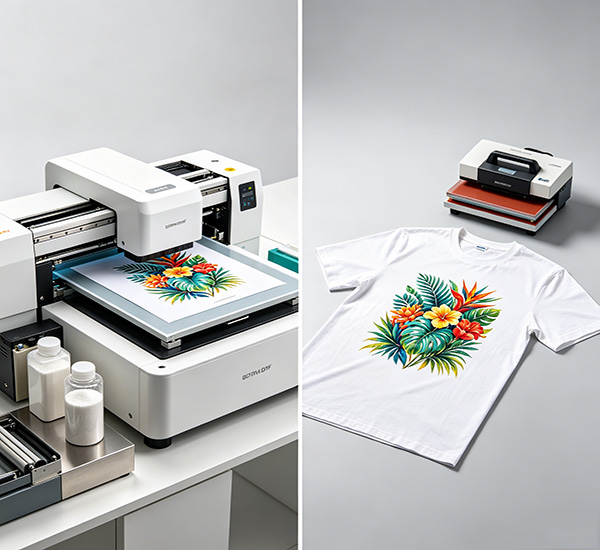
DTF gets its name from "Direct-to-Film" – a process where designs are printed directly onto a PET film, a key substrate in PET digital Printing. To achieve optimal ink fixation and image sharpness, the PET film is typically pre-coated with a cationic ink absorption coating, which instantly immobilizes the anionic pigment ink droplets upon contact, preventing bleeding and ensuring vivid color reproduction. Afterwards, hot-melt adhesive powder is evenly applied over the still-wet printed pattern, melted, and dried. The finished PET film is then trimmed, and the design is heat-pressed onto various garments to complete the garment printing process.
Why emphasize this method? Since around 2021, DTF printing has steadily gained market share in the garment printing industry and is now one of the mainstream methods. According to Google Trends, the search volume for "DTF Printer" has been climbing since 2021. A major reason for the popularity of DTF printers lies in their distinct advantages:
Convenient printing workflow
Short preparation cycle
Fast printing speed
High production efficiency
Reliable output quality
Whether it's meeting bulk production needs during peak seasons or handling urgent custom orders during slower periods, DTF printers handle the job with ease.
Advantages of DTF Printers
Compared to DTG (Direct-to-Garment) printing, DTF — a prominent method in both heat transfer printing and textile digital printing — requires no pre-treatment spray, eliminating the pre-treatment step entirely. Compared to screen printing, DTF eliminates the need for plate-making, film output, and many other complex steps. With DTF, you simply design the artwork in graphic software, correctly operate the machine following a technical guide, and complete the process: print → powder coating → drying → heat pressing. The performance of the transfer film is largely determined by the cationic ink absorption coating applied onto it. A high-quality cationic ink absorption coating, such as a water-peelable formulation with excellent ink anchoring and no water-edge defects, ensures that ink droplets are instantly fixed, resulting in vivid colors and sharp image edges.
Wash durability: For textile hot stamping applications, DTF prints can withstand repeated washing and abrasion. The color fastness to washing reaches grade 4–5. For a summer T-shirt washed three times a week, the print can last up to two years. This durability is further enhanced when the cationic ink absorption coating forms a strong yet peelable interface between the ink layer and the film, providing reliable transfer adhesion without compromising wash resistance.
Versatility: In the field of textile digital printing, compared to DTG or dye-sublimation printing, DTF printing is not limited by substrate constraints. It can be widely applied to fabrics such as cotton, polyester, wool, nylon, Lycra, cotton-linen blends, denim, silk, and many others. In this sense, DTF printers can truly be called the "universal garment printer." The broad substrate compatibility is made possible by the consistent ink-fixing performance of the cationic ink absorption coating, which functions independently of fabric type.
Environmental benefits: Before DTF printing emerged, screen printing was one of the giants in the garment printing industry. Screen printing is known for high-volume production, providing reliable output speed during peak seasons. However, the preparation required before screen printing is highly time-consuming, and the process generates significant wastewater and pollution. From an environmental perspective, DTF printing — as a modern heat transfer printing technology — is far superior: it produces no wastewater or emissions during operation. The machine is equipped with a smoke purifier that eliminates fumes internally. The only precaution is preventing hot-melt powder dust from escaping during printing. Additionally, the water-based nature of the cationic ink absorption coating contributes to a low-VOC, eco-friendly workflow, aligning with modern sustainability standards.
How to Choose the Right DTF Printer?
In the field of textile hot stamping, different DTF configurations come with different price points. More features and higher configurations command higher prices. But does that mean you should always go for the highest configuration with the most features? The answer is: find what suits you best. While traditional manufacturers have their strengths, some emerging DTF printer manufacturers are more innovative in certain aspects, designing more thoughtful new products to leverage DTF's advantages and adapt to local markets. For example, some manufacturers export DTF printers to many countries worldwide, making functional modifications to accommodate regional climates. In addition to printer hardware, the compatibility and performance of the cationic ink absorption coating—such as its viscosity (<2500 mPa·s) and pH stability (4.0–6.0)—should also be considered, as these factors directly affect ink fixation quality and machine reliability under varying temperature and humidity conditions.
Specifically, when selecting a DTF printer that truly fits your garment printing business, you need to carefully consider the following factors:
1. Choose According to Market and Business Needs
DTF printers come in many types, such as:
High-precision, high-quality A3-sized DTF printers: Suitable for moderate production volumes but with extremely high print quality for T-shirts.
Large-format, high-performance DTF printers: Capable of batch production, large-format printing, and special finishes.
Printers equipped with 4 or 5 printheads: Enable sustained, stable high-speed output, meeting the bulk production needs of garment factories.
As a business operator, you should already have a clear understanding of your local printing market, its demands, and characteristics. Ask yourself the following:
How large is the market demand?
How many orders are there?
What are the print volumes?
Does demand remain consistent between regular and seasonal peak periods?
Are there special printing requirements (e.g., extra-large formats, all-black designs, requiring exceptional wash and abrasion resistance)?
Do you need to handle emergency or rush orders?
Once you have answers to these questions and a clear grasp of your market and business needs, you can narrow down your options based on the features and types listed above to find the DTF printer or complete solution suited to your garment printing business. If you find that some configurations don't align with your needs, flexible DTF printer configurations are available – you can consult with your supplier to obtain the most suitable DTF printer.
2. Critical Components to Understand When Choosing a DTF Printer
Understanding the configuration and key components of a DTF printer is extremely helpful when making your selection! Otherwise, you may feel confused when encountering unfamiliar parameters and terms. More importantly, you might not understand why seemingly similar printers with similar configurations can differ significantly in price: some command higher prices simply because of a well-known brand but may not be worthwhile, while others deliver high performance hidden behind parameters and configurations but may be overlooked because the brand is less recognized. As a successful investor, try to avoid these traps.
Printhead
The printhead is one of the most critical components of a DTF printer. It determines printing performance and quality, serving as the core of any inkjet printer. If the printhead becomes clogged or burns out, it severely affects the machine's overall operation. Most manufacturers on the market use Epson printheads. For more demanding applications, the I3200-A1 printhead is often chosen, as it generally offers higher performance and longer service life compared to other options.
Mainboard (Motherboard)
The mainboard coordinates the various components of the printer, including the printhead(s), ink delivery system, and other parts, to produce high-quality output. It is a key part of overall printer reliability.
White Ink Circulation System
A DTF printer places high demands on the smooth flow of white ink. Due to the unique composition of white ink, most machines come equipped with a white ink circulation system. This system includes components such as the circulation pump and circulation filters. Proper white ink management prevents sedimentation and clogging, which are common issues with white pigment inks.
3. DTF Consumables – DTF Ink
In heat transfer printing, DTF ink is a water‑based pigment ink. This type of ink offers superior lightfastness, moisture resistance, and oxidation (including ozone) resistance, which explains why prints made with it can last a long time on garments. High‑quality DTF ink is characterized by strong color saturation, a wide color gamut, high color fidelity, and prints that remain vibrant for extended periods. To fully utilize these advantages, the transfer film must be coated with a high‑performance cationic ink absorption coating. This coating instantaneously immobilizes the anionic pigment ink droplets through electrostatic attraction, preventing bleeding and ensuring that the intrinsic color saturation and fidelity of the ink are faithfully reproduced on the final print.
Characteristics of high‑purity, high‑quality DTF ink:
Non‑clogging: At room temperature, with automatic or manual printhead maintenance, the ink does not dry out even after 24 hours of standby, improving the printer's operational efficiency. The compatibility between the ink and the cationic ink absorption coating further reduces nozzle issues because the coating’s controlled pH (4.0–6.0) and absence of volatile components help maintain stable ink drop formation.
Economical usage: Compared to standard inks, it can cover 10–20 % more printed area per volume, reducing consumption and lowering costs. This efficiency is enhanced by the cationic ink absorption coating, which creates a uniform receptive layer that maximizes ink transfer and minimizes waste.
High color fidelity: It reproduces a broader range of colors with vibrant, realistic output, achieving near‑photographic print quality. The coating’s ability to eliminate water‑edge defects and snowflaking ensures that every shade and tone is rendered with true‑to‑original accuracy.
Sharp edges: It prints crisp pattern edges, ensuring clean powder application without adhesive residue or "glue lines." The cationic ink absorption coating anchors ink precisely at the intended dot location, preventing lateral spread and delivering razor‑sharp boundaries.
Soft hand feel: Manufactured with premium raw materials, the ink produces bright, soft prints with superior water resistance. When combined with the thin, flexible film formed by the cationic ink absorption coating, the final transferred image retains a soft tactile quality on fabric, without stiffness or cracking.
4. DTF Consumables – DTF Hot‑Melt Powder
Several types of hot‑melt adhesive powder are available on the market to meet different production needs, including PA (polyamide), EVA (ethylene‑vinyl acetate), and TPU (thermoplastic polyurethane) powders. For optimal transfer quality, high‑purity TPU powder is recommended. 100 % TPU powder offers a cleaner composition (no impurities), better stretch resistance, cleaner powder application (no residue), crisp transfer results with fine details and no ghosting, as well as good resistance to scratching and yellowing.
5. DTF Consumables – PET Film
DTF printing, an important technique within PET digital Printing, involves printing onto a PET film (or transfer paper), which is then transferred to garments using a heat press. PET films are available as single‑coated and double‑coated variants. Based on peeling temperature, they are also classified as cold‑peel, warm‑peel, and hot‑peel films. The performance of the PET film is largely determined by the cationic ink absorption coating applied onto its surface, which enables strong ink absorption through electrostatic attraction and ensures defect‑free printing.
High‑quality DTF transfer film is characterized by:
Uniform coating
Strong ink absorption (achieved by a high‑performance cationic ink absorption coating with controlled solids content of 25±2% and viscosity <2500 mPa·s)
Accurate registration with minimal slipping
Clean powder shake‑off
Good release properties
Uniform adhesive application and curing for high wash durability
Soft, elastic, crack‑resistant hand feel
Recommended transfer conditions: 130–160 °C, 8–15 seconds.
6. DTF Printer Price
Currently, DTF printer prices vary widely, and different manufacturers have different pricing strategies. Component prices can also fluctuate over time, and government policies supporting the industry may affect costs. Therefore, after understanding the entire operational process and ensuring the brand meets quality standards, you should evaluate the machine based on the factors outlined above. Extended guidance on total cost of ownership and support requirements is discussed under "After‑Sales Support and Training."
7. After‑Sales Support and Training
Whether the supplier provides comprehensive after‑sales support is a key consideration when purchasing a printer. Ask about shipping logistics, the length of the printer warranty, routine maintenance procedures, replacement frequency for consumable parts, and other details.
Using a DTF printer is not difficult, and proper training can help a great deal. Many suppliers offer on‑site instruction and technical support, which helps customers better understand and operate the equipment.









 Network Supported