
Abstract
Against the trend of environmental protection, waterborne coatings have emerged as a sustainable solution to enhance the barrier performance of paper. This article elaborates on key factors affecting the barrier properties of coated paper, including coating process, base paper properties, coating methods, and the inherent characteristics of waterborne barrier coatings, providing practical guidance to optimize paper packaging performance.
Introduction
Plastic packaging offers convenience but poses severe environmental challenges due to its non-biodegradable nature. Paper, with its recyclable and repulpable advantages, is increasingly favored as an eco-friendly alternative in food packaging to replace traditional plastics. However, the porous fibrous structure of paper results in poor barrier properties against water vapor, oil, water, and other liquids, limiting its wider application.
Waterborne coatings have thus been developed. Unlike conventional polyethylene (PE) extrusion-coated paper products, waterborne coatings facilitate the repulping of disposable paper packages, enabling partial replacement of virgin pulp in paper mills and minimizing the environmental footprint of disposable paper packaging.
As a leader in dispersions and resins, BASF is committed to sustainability through innovative products. Its high-performance waterborne barrier Joncryl® HPB (High Performance Barrier) series delivers excellent paper barrier properties, reduces plastic usage, lowers solvent emissions, and improves the carbon footprint of packaging.
Key Factors Affecting Barrier Properties of Coated Paper
1. Coating Process
Barrier coatings work by applying a water-based layer on the paper surface to block the passage of liquids and gases. Generally, higher coating weight improves barrier performance but increases costs, requiring a balance between performance and cost in production.
Uncoated base paper for food packaging often has uneven surface porosity, moisture, basis weight, and thickness, causing waterborne coatings to penetrate into the paper during drying and leading to uneven coating layers. Pre-treatment or double coating can effectively mitigate this issue, ensuring more uniform coating and better barrier performance compared to single coating.
Drying conditions significantly impact barrier effectiveness. Each styrene-acrylic emulsion has an optimal drying temperature to maximize its barrier properties. Hot-air oven drying is preferred for barrier coatings, as it enables uniform drying via adjustable drying curves and effectively removes residual volatile odors from the coating.
2. Base Paper Properties
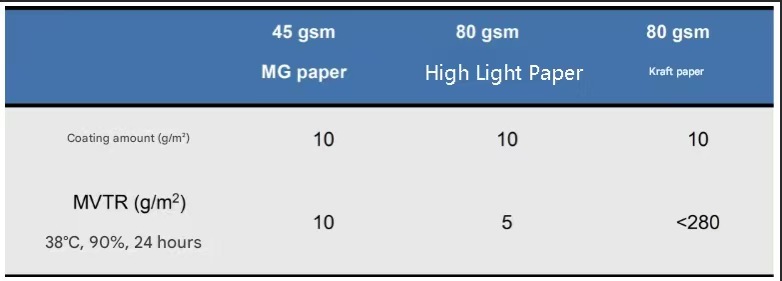
Properties of base paper—including smoothness, air permeability, gloss, and fiber composition—determine its absorbency and thus the final coating effect. Even with the same barrier coating, process, and coating weight, different base papers yield vastly different barrier results due to variations in surface roughness and structural uniformity.
3. Coating Methods
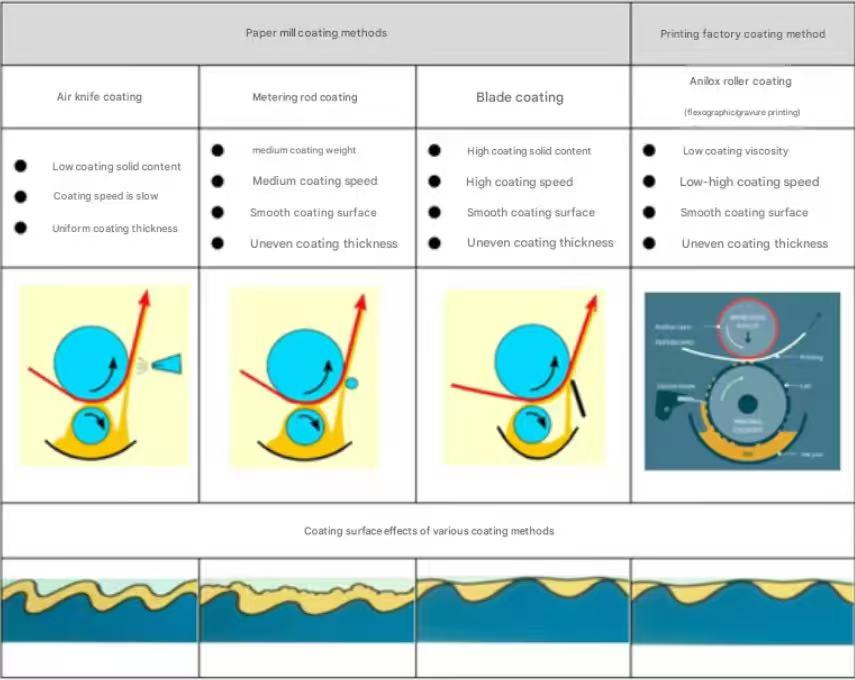
Common coating methods include blade coating, metering rod coating, air knife coating, and anilox coating. The first three are widely used in paper mills, while anilox coating is common in printing plants. The selection should be based on base paper basis weight, target coating weight, and barrier requirements.
For example, air knife or anilox coating is suitable for applying approximately 3 g/m² coating on 20–30 g/m² hamburger paper to meet Kit 6 grease resistance, achieving uniform coatings and high barrier performance at low coating weights.
4. Inherent Properties of Waterborne Barrier Coatings
Water vapor barrier coatings: Reduce the solubility coefficient by maximizing the polarity difference between the coating and water vapor; higher coating weight and thickness enhance water vapor barrier performance.
Block or delay the penetration of oily substances through film formation, influenced by polymer solubility, glass transition temperature, core-shell structure, acid value, and pH.
Coatings may offer multi-functional properties (oil resistance, water resistance, water vapor barrier, heat-sealability) or single-function barrier performance. Selection should align with specific application needs.
Conclusion
With the tightening of plastic restriction policies, the era of "replacing plastic with paper" has arrived. Material suppliers represented by BASF are actively promoting innovative barrier coatings to meet the market's demand for sustainable green packaging. The development and application of high-performance waterborne barrier coatings will further unlock the potential of paper in eco-friendly packaging.





Sitemap Blog Xml Privacy Policy
Copyright @ Runshine New Materials(FoShan) Co.,Ltd. All Rights Reserved.
 Network Supported
leave a message
Scan to wechat :

Scan to whatsapp :